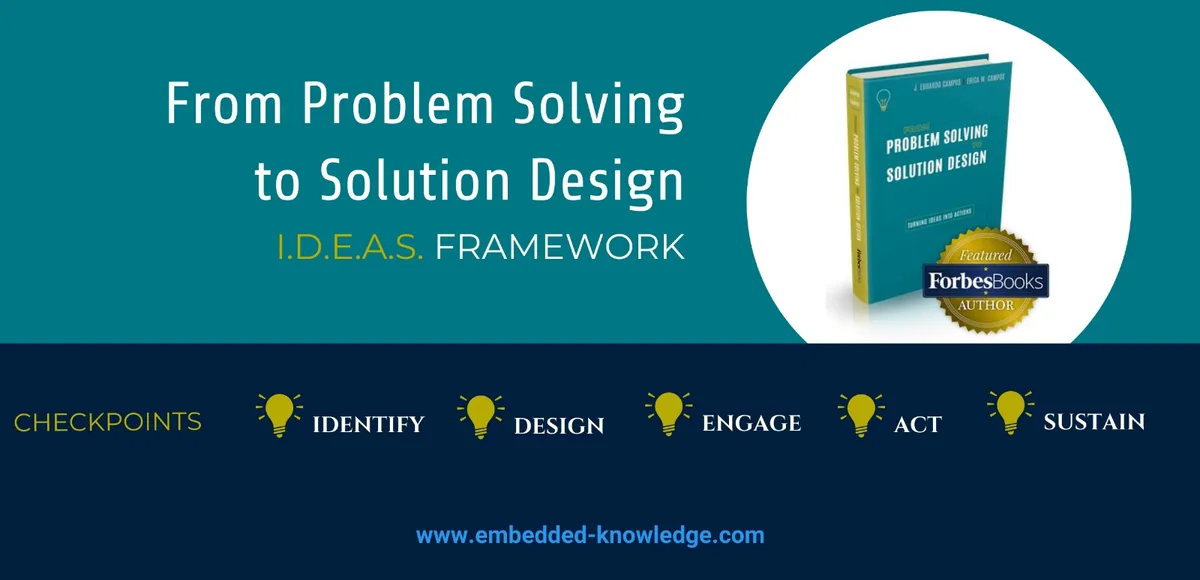
The I.D.E.A.S. Framework
Five checkpoints to leverage the embedded knowledge in your organization
Complex organizational problems are rarely solved by a flash of insight. They are solved by working through them in order: understanding the problem before designing for it, designing before deciding, deciding with the people affected, implementing under a governance model, and planning for what happens after everyone has moved on.
I.D.E.A.S. is the method behind From Problem Solving to Solution Design: Turning Ideas into Actions. Each checkpoint below lists what to do and what you should have in hand before moving to the next one.
Identify
Before anything else, work out what the real problem is — and accept that there may be more than one.
Key actions
- Define the Essential Problem
- Prioritize your actions
Expected results
- The Essential Problem is defined
- Actions are prioritized to solve the Essential Problem
Design
Agree on what a good outcome looks like, then put real options on the table and weigh them against each other.
Key actions
- Set your goals for the Solution Design
- Design Solution options
Expected results
- Solution Design goals are clearly agreed upon
- Options are defined, weighted, and prioritized
Engage
No solution survives without the people who have to live with it. Map them, understand what moves them, and bring them in.
Key actions
- Prepare your Stakeholder Engagement
- Inform the Decision-Making process
Expected results
- Stakeholder Map and Engagement Plan are defined
- Communications Plan is created
Act
Implementation is where most solutions are lost. It needs a strategy and a governance model, not good intentions.
Key actions
- Drive your Implementation Strategy
- Execute your Governance Model
Expected results
- Implementation Strategy is defined
- Governance Model guarantees smooth implementation
Sustain
Organizations change around the solution. Plan for that, and build a way to learn from what fails.
Key actions
- Leverage the Organizational Lifecycle
- Create a Feedback Loop
Expected results
- Change Management strategies are agreed upon
- Feedback loop is defined and failure recovery planned
I.D.E.A.S. into Actions
The five checkpoints and their actions, at a glance.
| Checkpoint | Actions |
|---|---|
| Identify |
|
| Design |
|
| Engage |
|
| Act |
|
| Sustain |
|
Downloads